
Japanese Minimalism: Principles for a Pared-Back Interior
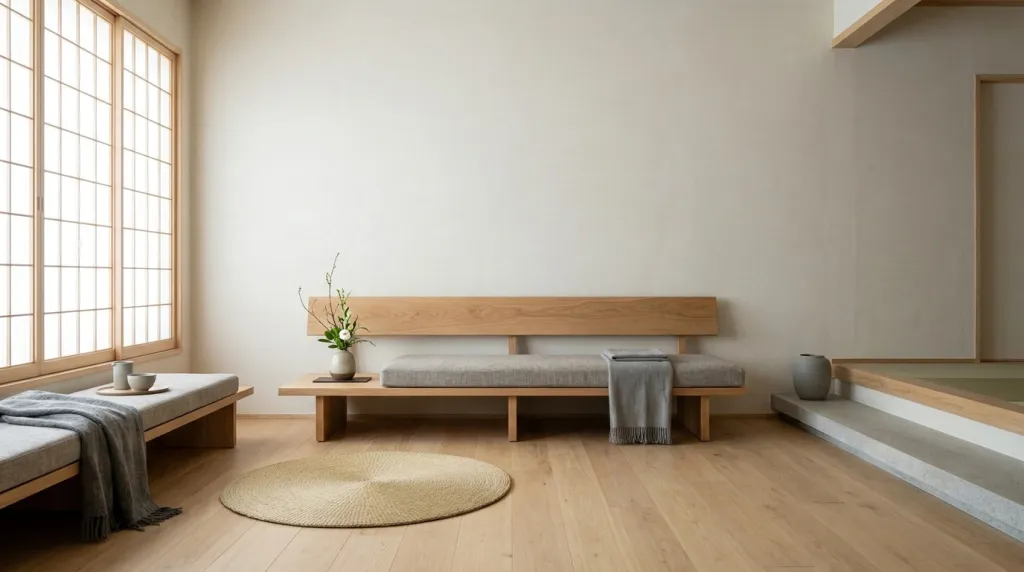
Owning fewer objects doesn't create emptiness, but a space to breathe where every remaining piece finally gains real importance. We'll guide you through the principles of Japanese minimalism to turn your home into a sanctuary of absolute serenity. By embracing concepts like Ma and Kanso, you'll learn to favor the essential and natural materials to bring lasting calm to your mind.
Emptiness as luxury: understanding the concept of ma
Once we understand that Japanese minimalism isn't about lacking something but about intention, let's explore the idea of constructive emptiness.
Giving space room to breathe through absence
Ma refers to that essential interval between two objects. It's never wasted empty space, but a necessary breath. Think of it as the silence between musical notes that gives the whole melody of your home its meaning.
Living in an airy room transforms your state of mind. By limiting visual stimuli, you actively reduce your everyday stress. Your mind can finally rest in an environment no longer saturated with information or clutter.
We recommend favoring smooth, open pathways through your space. Keeping walkways clear between your furniture ensures total freedom of movement. That's how energy flows unobstructed through your home.
Stripping away artifice with the kanso principle
Kanso embodies a pursuit of radical simplicity. We encourage you to remove anything that doesn't serve a clear function. Gratuitous ornamentation no longer has a place in your quest for serenity.
Identify the visual clutter crowding your eye. Accumulated knick-knacks or overly busy patterns disrupt a room's harmony. You need to sort through your belongings with brutal honesty to protect your inner well-being.
Choose your objects based on their real usefulness. Every decorative element should serve a clear purpose or bring quiet joy. Keep only the essentials to elevate your space. It's a genuine everyday discipline.
This visual clarity brings immediate peace. Your home then becomes a protective sanctuary.
3 natural materials for a serene atmosphere
Once the space is decluttered, your choice of materials becomes key to creating authentic, organic warmth.
Light wood and organic fibers
Favor light woods like oak or ash. These woods bring natural luminosity and a soft, tactile quality. They form the solid foundation of long-lasting furniture.
Add linen or raw cotton textiles for comfort. These organic fibers breathe and bring living texture to seating. Avoid synthetic materials that break the natural harmony. Choose artisanal weaves and imperfect finishes instead.
Use bamboo for your storage accessories. It's a renewable, lightweight resource that fits beautifully with the overall aesthetic.
Wood connects us to the earth. Its presence instantly calms a room.
Handcrafted ceramics and washi paper
Showcase stoneware vases with organic, irregular shapes. Ceramics carry the trace of the artisan's hand. Each piece becomes a unique, treasured object.
Choose washi paper lighting to diffuse light. This material filters light in a soft, warm way. The mood becomes hushed, almost timeless.
Choose handmade objects with distinctive quirks. Imperfection is a major aesthetic strength in Japanese style. It tells a story that industrial perfection never can.
How do you pare down a room without making it feel cold?
Simplicity shouldn't mean clinical emptiness; here's how to keep soul in your space while still simplifying.
Choose low-profile, multifunctional furniture
Choose nightstands or stools with clean, straight lines. Low furniture opens up sightlines and visually enlarges a bedroom's sense of space. It's a simple trick for transforming a small room. Prioritize quality over quantity.
Open up the visual perspective by lowering the overall height of your furniture. Fewer physical barriers help energy move more freely. You feel less boxed in within your own home.
Optimize storage to effectively hide everyday clutter. Use wooden boxes or Japandi Style woven baskets. An orderly space brings the mental clarity essential for rest.
Multifunctional furniture saves space. A stool can double as a side table or extra seating.
Warm up the space with an earthy palette
Pair off-white with shades of beige and gray. These muted colors create a soft, protective envelope. They catch the light without ever straining the eye.
Create contrast with subtle touches of charcoal black. A thin frame or a black lamp base underscores the architecture. It adds character without weighing down the overall look.
Play with textures to add depth. A thick rug or a lime-washed wall keeps things from feeling flat and cold.
Earthy color evokes nature. It grounds your decor.
The beauty of asymmetry and wear
Finally, the ultimate step in Japanese minimalism is learning to accept, and even cherish, the passage of time on our belongings.
Celebrating wabi-sabi through weathered objects
Accepting the marks of time on natural surfaces strengthens authenticity. A scratch on wood or a patina on leather are proof of a life lived. Don't chase flawless perfection.
Favor visible repair over automatically buying new. Kintsugi, for example, elevates cracks with gold. It's a philosophy of resilience applied to objects. Respect what you already own. Give your treasures a second life.
Choosing decor pieces with a lived history adds character. An object that has traveled or aged offers a unique emotional depth. Your home then becomes a reflection of your own journey.
Imperfection is the truest form of beauty. It connects us to our own humanity.
Cultivating subtlety through shibui aesthetics
Seek out a quiet elegance that reveals itself over time. Shibui doesn't try to impress at first glance. It's a calm beauty that rewards close attention.
Avoid loud colors in favor of muted tones. Restraint is a virtue in Japanese design. Suggestion is preferred over showing everything at once.
Prioritize the quality of craftsmanship over appearance. A beautiful object is defined by its structure and durability. Aesthetics naturally follow from function and care.
Subtlety is the ultimate luxury. It offers lasting, deep satisfaction.
Embracing Japanese minimalism turns your home into a sanctuary through fertile emptiness (Ma), radical simplicity, and natural materials. Start decluttering now to free your mind, and choose authentic, long-lasting pieces. Let serenity shine through in a pared-back interior where every object tells a unique story.
FAQ
What is the concept of "Ma" in Japanese decor?
The concept of Ma represents the interval, the silence, or the constructive emptiness between two objects. In your home, it isn't wasted space, but a necessary space that lets elements breathe and energy flow freely.
By incorporating Ma, we aim to reduce visual stimuli to calm your mind. In practice, that means open walkways, uncluttered walls, and generous spacing between furniture pieces to create a true sanctuary of serenity.
How do you apply the Kanso principle of simplicity at home?
Kanso is a pursuit of radical simplicity that involves removing anything without a clear function or pure beauty. To embrace it, we recommend sorting through your belongings with brutal honesty, clearing out visual clutter and gratuitous ornamentation that crowd your view.
At Japandi Style, we favor objects based on real, everyday usefulness. By keeping only the essentials, you turn your home into an orderly space that supports the mental clarity and immediate peace of mind you need.
What natural materials are essential for a pared-back interior?
To create a warm, organic atmosphere, we recommend light woods like oak or ash, paired with natural fibers such as linen, raw cotton, or bamboo. These materials bring a soft, tactile feel and natural light to your room.
We also like to incorporate handcrafted elements such as stoneware ceramics and washi paper lighting. These materials filter light in a soft, diffused way and celebrate handmade craftsmanship, creating an authentic link between your home and nature.
How do you pare down a room while keeping it feeling warm?
The trick to avoiding a "clinical" look is to choose low-profile furniture that opens up sightlines, while warming the space with an earthy color palette. Pair off-white with soft beige and gray tones, plus a few touches of charcoal black to highlight the architecture without weighing it down.
We also suggest playing with texture, like a thick rug or natural textiles, to add depth. Multifunctional furniture and attractive storage solutions help hide clutter while keeping the space full of character and comfort.
What does the philosophy of Wabi-Sabi mean in minimalism?
Wabi-sabi is a philosophy that celebrates the beauty of imperfection and the passage of time. Rather than chasing flawless, artificial perfection, we invite you to embrace the patina on wood, irregular shapes, and objects with a story to tell.
This approach values resilience, especially through the art of Kintsugi, where broken objects are repaired with gold. By accepting these marks of a life lived, your decor gains emotional depth and connects you to a more human, authentic form of beauty.
How would you define the Shibui aesthetic in interior design?
The Shibui aesthetic is a quiet, subtle elegance that doesn't try to impress at first glance. It's a calm beauty, built from muted colors and understated tones, that fully reveals itself through close attention and daily use.
For us, Shibui represents the ultimate luxury of restraint. It highlights craftsmanship and structural durability over showy appearance, offering lasting visual satisfaction and deep serenity in your living space.