
Japanese Shoji: A Guide to Sliding Room Dividers
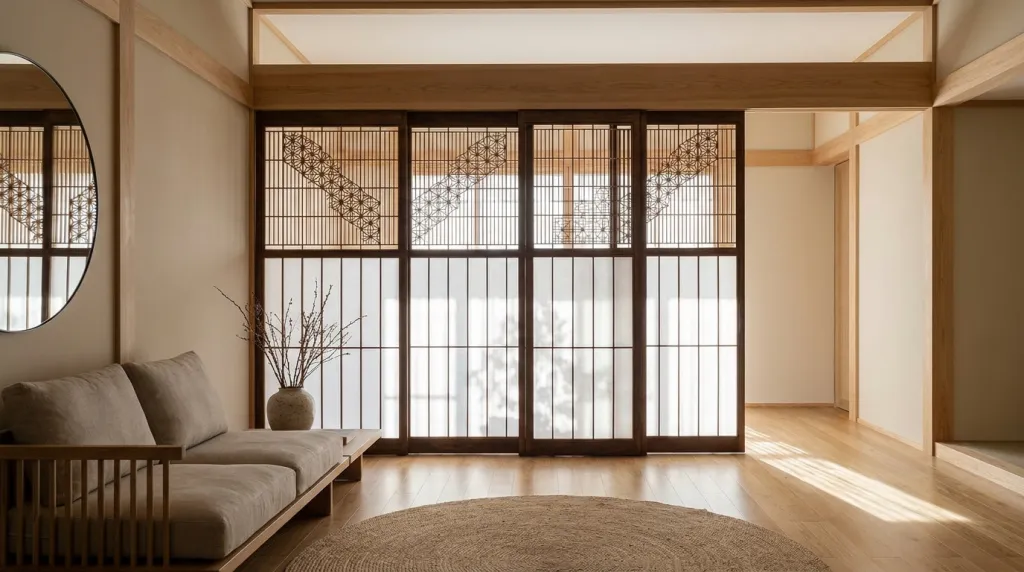
You want to transform your home into a haven of peace while making the most of every square foot of your living space. Let us show you how the Japanese shoji reshapes your rooms with elegance, thanks to its handcrafted wooden frame and translucent washi paper. This article uncovers the secrets of its centuries-old craftsmanship and offers practical tips for bringing this luminous room divider into a modern layout.
Origins and Traditional Craftsmanship of the Japanese Shoji
Having covered the overall aesthetic, let's look at how the shoji's very structure gives it its unique character.
The Role of the Kumiko Frame in Structural Stability
The kumiko technique relies on the meticulous assembly of thin wooden slats. The work is done without a single nail or screw. Grooves cut to millimeter precision guarantee the strength of the whole. This time-honored craftsmanship produces a frame that's lightweight yet remarkably stable.
We often favor noble species like cedar or Japanese cypress. These woods have a natural resistance to ambient humidity. Their fine grain gives an impeccable finish to the touch.
The geometric patterns create a soothing visual rhythm throughout your home. They structure the space with quiet, authentic elegance.
A well-made frame lasts for decades without ever shifting. It is the true foundation of traditional Japanese craftsmanship.
The hand-fitted joinery is a feat of skill. No metal ever disturbs the purity of the wood.
The Unique Properties of Traditional Washi Paper
Washi paper is made from sturdy natural fibers, mainly derived from mulberry bark. Its grainy texture is distinctive. It proves far more durable than standard industrial paper.
Washi acts as a natural filter for light. It softens the sun's rays as they enter the room. The atmosphere becomes serene. Cast shadows stay delicate.
This paper lets the room breathe while still insulating it effectively. It plays an active role in your home's thermal comfort.
Its matte whiteness captures every nuance of daylight. It's a living material.
Why Choose These Partitions for a Japandi Interior?
This artisanal technical mastery explains why these elements blend so naturally into today's hybrid interiors.
The Balance Between Japanese Minimalism and Nordic Comfort
The Japanese shoji unites Japanese rigor with Scandinavian softness. It creates an interior that's uncluttered yet welcoming.
The frame's light wood echoes Nordic furniture. The washi paper complements linen or wool textiles. Together they create a perfectly harmonious visual balance.
This fusion fosters a sense of calm. You feel sheltered without feeling closed in.
The design is both functional and beautiful. That's the very essence of the hybrid style.
A Solution for Reshaping Spaces Without Full Partitions
Sliding panels require no swing clearance. They glide along the walls or tuck away out of sight. That makes them ideal for small urban spaces.
You can create a reading nook in an instant. The divider stays light and reversible. Privacy is preserved without sacrificing openness.
Unlike drywall, shoji lets energy flow freely. The space stays fluid and dynamic.
Your home adapts to your needs. Shoji is a living partition.
3 Modern Ways to Transform Your Living Space
But how, exactly, can you bring these panels into your home without turning your living room into an ancient temple?
Sliding Doors to Separate Rooms
Installation relies on invisible tracks mounted directly to the ceiling for a minimalist look. The panels then seem to float weightlessly in the air. It's a particularly elegant architectural solution.
Use them to section off a quiet home office within your living room. They also hide a cluttered closet beautifully behind their lattice. The transition between rooms becomes seamless. The design stays cohesive throughout the home.
The panels slide silently and smoothly. That immediately reinforces the calm of your interior.
Once closed, these doors function like true works of art. They dress up your walls with understated visual sophistication.
Upkeep stays minimal day to day. It's a durable, stylish choice.
Movable Screens for Total Flexibility
Renters love these freestanding, portable structures. They require no complicated drilling into walls. You simply move them wherever the moment calls for.
Kumiko frames come in a variety of geometric designs. Some are understated, others more intricate. They cast beautiful shadows.
We've identified several uses for these structures:
A child can move these panels with no effort at all. It's the ultimate nomadic decor piece.
A screen adds an instant touch of poetry.
A Practical Guide to Installation and Longevity
For this aesthetic journey to last, the installation needs to be just as solid as it is beautiful.
Floor or Ceiling Mounting, Depending on Your Layout
We generally recommend lightweight hardware for your partitions. Wood-frame structures weigh very little. Slim tracks are more than enough to hold them in place. Avoid overly heavy or complicated systems.
Always check that the guide tracks are perfectly level. Precise alignment ensures smooth sliding. It also prevents premature wear on the frames. Careful installation is what guarantees the whole system's durability.
Ceiling suspension frees the floor of any visual obstruction. A floor track, however, offers greater mechanical stability. Choose based on your current flooring. Both options look equally beautiful in a Japandi interior.
A level and a drill are all you need for installation. It's a project well within reach of any DIYer.
A careful installation makes all the difference in the final result.
Cleaning and Replacing the Paper Covering
Regular dusting is the key. Use only a duster or a dry cloth. Never wet traditional washi paper. Dust lifts off the surface easily without any scrubbing.
If the paper tears, there's no need to panic. You can replace just a single section of the frame. Simply dampen the edges to loosen the old covering. It's a simple, budget-friendly repair.
A light mist of water helps re-tighten washi after it's applied. As it dries, it becomes perfectly smooth again. It's a trick straight from master craftsmen. The paper regains its original tension.
With a little care, the paper lasts for years. Its patina only grows more beautiful with time.
It's a material that deserves respect. Your home will reward you for it.
The Japanese shoji transforms your interior through the union of kumiko woodwork and washi paper, offering diffused light and unmatched versatility. Bring these panels into your home now to shape your space with elegance. Your future Japandi space will gain lasting serenity and comfort. Elevate your home with this centuries-old art.
FAQ
What Is a Traditional Japanese Shoji Partition?
Shoji is a sliding partition emblematic of Japanese architecture. It consists of an openwork wooden frame, called kumiko, over which translucent washi paper is stretched. This design lets you structure your space while still allowing soft, natural light to flow through.
We especially value this solution for its ability to create visual separation without blocking off the space. It's a key element for establishing an atmosphere of serenity and lightness, characteristic of both traditional and contemporary Japanese design.
How Does Washi Paper Diffuse Light in a Room?
Unlike glass, washi paper has a unique fibrous texture that acts as a natural filter. It softens the sun's rays, eliminating glare and turning outdoor light into an even, muted glow. This diffusion creates delicate shadows and a calming atmosphere throughout your home.
Beyond its aesthetic qualities, this handcrafted paper also helps regulate a room's temperature and acoustics. Its fibrous structure, made from mulberry bark, offers surprising durability while maintaining an opacity that's ideal for preserving your privacy.
What Is the Kumiko Technique Used for Panel Frames?
Kumiko is an ancient art of assembling thin wooden slats with millimeter precision, without using any nails, screws, or glue. Each piece is grooved to interlock perfectly, forming geometric patterns that give the partition its stability and rigidity.
This traditional method produces a frame that is both lightweight and remarkably stable, able to last for decades. By choosing species like cedar or cypress, we ensure a piece that naturally resists humidity while giving your decor an elegant wood-grain finish.
How Do You Incorporate Japanese Partitions into Japandi Decor?
Shoji is the perfect bridge between Japanese minimalism and Scandinavian comfort. For a successful Japandi look, we recommend pairing the light wood of the frames with natural textiles like linen or wool. This blend of textures creates a harmonious visual balance.
You can use these panels as sliding doors to section off a home office, or as movable screens to define a sleeping area. They let you reshape your square footage to fit your daily needs, all while keeping energy and natural light flowing freely.
How Do You Maintain and Repair the Paper on a Shoji Panel?
Routine care simply means light dusting with a duster or a dry cloth. It's important never to wet traditional washi paper. If a section tears, the frame's modular design lets you replace just the damaged part by dampening the edges to loosen the old paper.
To smooth out a paper that's slightly wrinkled, you can mist it with a very fine layer of water. As the fibers dry, they contract and tighten back into a perfectly smooth surface. It's a living material that, with a little care, gains character over the years.